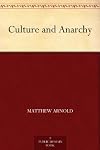
Culture and Anarchy
by Matthew Arnold
On This Page
Description
First published in 1869, Culture and Anarchy debates questions about the nature of culture and society. Arnold asks what good culture can do and how it can best be disseminated. This edition reproduces the first book version and enables readers to appreciate its historical context and its continued importance. - ;'The men of culture are the true apostles of equality.'. Matthew Arnold's famous series of essays, which were first published in book form under the title Culture and Anarchy in show more 1869, debate important questions about the nature of culture and society that are as relevant now as they h show lessTags
Recommendations






























Member Reviews
I had heard others speak of this book as if it were a cult classic. Any wonder. There are so many things going on in this work. I am still trying to see where Matthew Arnold fits in with the likes of Edmund Burke, John Stuart Mill, David Ricardo, Thomas Malthus, and Herbert Spencer. He was a professor of poetry by profession, and his niece, Mrs Humphrey Ward, became a metonym for a conservative wowser. So he was hardly a John Stuart Mill, yet he was also rather short of being a Herbert Spencer. He seemed to be the reverse of a modern Australian Liberal (not liberal) - he did not support free trade but looked to the cultural elite, while remaining socially conservative. The brief introduction eludes to the lack of definitions in the show more work, and this is supported by a critique of the work by Henry Sidgwick entitled The Prophet of Culture (provided as an appendix). Indubitably, the two were friends, but with some rather major philosophical differences. There are extensive notes and these are important due to the number of then-contemporary social, political, cultural, and religious debates (as indicated by the list of important thinkers above) that would be lost on most modern readers (or me, at least). These are rather important to understanding the context but I suspect the different disciplinary groups did not necessarily cross paths in their intellectual outputs. For my own memory, it is useful to outline some of Arnold's key ideas. First, culture is the seeking (as opposed to achieving) perfection in the pursuit of reason and the will of God. The phrase "sweetness and light" is used by Arnold to refer to the pursuit of beauty (in the Hellenistic sense) and light as intellect. Sidgwick counters with "fire and strength" as being more important to improving society (referring, in particular, to religion). Arnold navigates two approaches to understanding culture (albeit somewhat difficult to articulate a precise definition of either) as Hebraising (referring to the Hebrew penchant for religious discipline) versus Hellenism (referring to the Ancient Greek aesthetic and penchant for reason). Arnold brings in the idea of class here (something completely overlooked by many modern works that assume the myth of egalitarianism in contemporary society is not a myth at all), and names the classes the Barbarians (the aristocracy), the Philistines (the middle class) and the Populace (the working class). Given the book was published in 1869, the "Populace" was still a few decades away from any formal political power, and class-based rioting was emerging as a problem for the likes of Burke (who had issues with the Lockean and Rousseauian conceptions of the social contract. Indeed, Arnold was a form of anti-Jacobin). Arnold was closer to Hobbesian support for a strong State, but tempered by the idea that representatives of each class should strive to represent their ideal best selves (as a class rather than individuals), and the idea of the State was to enable such striving for social and political perfection. There were a few snippets that drew lines where the State should and should not intervene, relating to Nonconformism and antidisestablishmentarianism (I always wanted to use that word - but I must qualify, it relates to then-contemporary debates over the disestablishment of the Church of Ireland [refer to the Irish Church Act 1869], rather than the Church of England - but I had to use the word!) rather than intervening to protect the poor (some Malthusian debate was definitely going on at this time in history). Nevertheless, Arnold was opposed to government "control for control's sake" (p. 170) over education policy, and preferred the Continental approaches to education that had clear strategic objectives rather than simply government control. Sidgwick puts some of this confusion to rest - he is by no means a fan of this particular piece of Arnold's work but empathises with his cause to strengthen society by increasing its culture. Here, Sidgwick's essay does a great service to Arnold's theme, and the two works together are important. Sidgwick (p. 172) surmises that Arnold "wishes for reconciliation of antagonisms" - be these Hebraism versus Hellenism, class differences, or culture and religion (or sweetness and light versus fire and strength) - in an effort to improve society. Without Sidgwick's contribution, it would be easy to miss Arnold's point. But that does not make the work of any less value. Some of these statements have been made by others (including the introduction), and Arnold's belief in the "law of perfection" reminds me of a scene from The Last Samurai where Tom Cruise narrates: "From the moment they wake they devote themselves to the perfection of whatever they pursue". This was a difficult read. Not like Sir Walter Scott's work where one can readily get bogged down in Gaelic dialogue, but because numerous reference to the notes (there are as many notes as pages) are necessary to understand the context, and there is so much jam-packed in this otherwise short essay, that it takes a while to sink in. While that should not diminish the importance of the work, if the attitude to difficult works today is anything to go by - where we are routinely told by lazy egoists (as opposed to egotists) if we cannot explain something to a three year-old child we don't understand it ourselves - then Arnold is amiss. But he was so close to being a futurist that this work ought to be more widely read, not as a cult classic (which arguably it deserves to be), but because we are reaching the culmination-point Arnold seemed to warn about,-
should we ever relegate "sweetness and light" to "fire and strength". show less
should we ever relegate "sweetness and light" to "fire and strength". show less
This philosophical dissertation on culture defines it as the study of perfection, the harmonious balancing of one's intellectual and artistic nature with the need for purpose and action. Despite its 19th century provenance, the book is illuminated by Arnold's clarity of thought and skill in language, which deliver an important and timely message to those of us today who wish to retain some shreds of humanity.
contains famous distinction between Hebraism and Hellenism in Western culture. Also commentary on conflicts of the time such as disestablishment of Irish church.
Unbelievably boring.
Trying to apply a starred rating to this thing is impossible. The assumptions and sense of what counted as evident reason that held 150 years ago don't really lend themselves to being parsed that neatly. I'll try to get a better review together soon.
Later: here's what I came up with: https://wp.me/p4LPys-lP.
Later: here's what I came up with: https://wp.me/p4LPys-lP.
Ex-lib. Waterloo (NY) library and historical society
Ratings
Members
- Recently Added By
Lists

Trinity College Booklist (1951): Class Ten, English Literature
358 works; 5 members
Author Information

223+ Works 3,793 Members
Matthew Arnold, a noted poet, critic, and philosopher, was born in England on December 24, 1822 and educated at Oxford University. In 1851, he was appointed inspector of schools, a position he held until 1880. Arnold also served as a professor of poetry at Oxford, during which time he delivered many lectures that ultimately became essays. Arnold show more is considered a quintessential proponent of Victorian ideals. He argued for higher standards in literature and education and extolled classic virtues of manners, impersonality and unanimity. After writing several works of poetry, Arnold turned to criticism, authoring such works as On Translating Homer, Culture and Anarchy, and Essays in Criticism. In these and other works, he criticized the populace, especially the middle class, whom he branded as "philistines" for their degrading values. He greatly influenced both British and American criticism. In later life, he turned to religion. In works such as Literature and Dogma and God and the Bible, he explains his conservative philosophy and attempts to interpret the Bible as literature. Arnold died from heart failure on April 15, 1888 in Liverpool, England. (Bowker Author Biography) show less
Some Editions
Awards and Honors
Notable Lists
Series
Belongs to Publisher Series
Work Relationships
Is contained in
Common Knowledge
- Canonical title
- Culture and Anarchy
- Original publication date
- 1867 - 1868 (original articles) (original articles); 1869
- First words
- My foremost design in writing this Preface is to address a word of exhortation to the Society for Promoting Christian Knowledge.
- Last words
- (Click to show. Warning: May contain spoilers.)But now we go the way the human race is going, while they abolish the Irish Church by the power of the Non-conformists' antipathy to establishment, or they enable a man to marry his deceased wife's sister.
- Original language*
- englanti
*Some information comes from Common Knowledge in other languages. Click "Edit" for more information.
Classifications
- Genres
- Nonfiction, Literature Studies and Criticism, Philosophy, History
- DDC/MDS
- 306.0941 — Social sciences Social sciences, sociology & anthropology Culture and institutions Social history Europe British Isles
- LCC
- HN389 .A72 — Social sciences Social history and conditions. Social problems. Social reform Social history and conditions. Social problems. By region or country
- BISAC
Statistics
- Members
- 828
- Popularity
- 33,016
- Reviews
- 6
- Rating
- (3.37)
- Languages
- 7 — Czech, English, Finnish, French, Italian, Portuguese, Spanish
- Media
- Paper, Audiobook, Ebook
- ISBNs
- 51
- ASINs
- 39