
Allan Bloom (1930–1992)
Author of The Closing of the American Mind
About the Author
Works by Allan Bloom
Associated Works
Common Culture: Reading and Writing About American Popular Culture (1995) — Contributor, some editions — 99 copies
Tagged
Common Knowledge
- Canonical name
- Bloom, Allan
- Legal name
- Bloom, Allan David
- Birthdate
- 1930-09-14
- Date of death
- 1992-10-07
- Gender
- male
- Education
- University of Chicago (Ph.B|1949|MA|1953|Ph.D|1955)
- Occupations
- academic
philosopher
classicist
professor - Organizations
- University of Chicago
Cornell University
Yale University
University of Toronto - Awards and honors
- Charles Frankel Prize (1992)
- Relationships
- Ajzenstat, Janet (mentee)
Wu, Michael (partner) - Cause of death
- liver failure
- Nationality
- USA
- Birthplace
- Indianapolis, Indiana, USA
- Places of residence
- Indianapolis, Indiana, USA
Chicago, Illinois, USA - Place of death
- Chicago, Illinois, USA
- Associated Place (for map)
- Illinois, USA
Members
Reviews
Closing of the American Mind: How Higher Education Has Failed Democracy and Impoverished the Souls of Today's Students by Allan Bloom
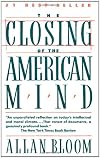
Unless you were attending a university when this book was published, or have a special interest in the general ongoing dialogue we call the culture wars, "The Closing of the American Mind" may not be on your radar. When it first came out in 1987, it caused quite a fracas and became, I'm sure to everyone's (including Allan Bloom’s) surprise, a bestseller. It's difficult for me to imagine a book by an unprepossessing University of Chicago professor on the debilitating effects of Heidegger show more and Nietzsche on higher education becoming a bestseller today. This may only serve to bolster Bloom's case that the "liberal" attitude of openness has gone a few steps too far.
Or it might be the direct effect of Bloom's "voice" - which is, despite what any of his intellectual confreres say, by turns elitist, rankly unegalitarian, and possibly anti-democratic in content; in tone, he often comes off as the curmudgeonly old grandfather shaking his newspaper at you and telling you to get off of his lawn. I personally have no problem with the elitism or anti-democratic attitudes when it comes to teaching. There are, quite simply, some books that are better than others, and some ideas that are better than others, and having to pretend otherwise is simply to play the ostrich's game of sticking our heads in the sand. The better books should be taught for the moral education of the student body while inferior books should be set aside (surely to be picked up by many people who, after graduating from university and having been introduced to the greats, choose to eschew them and read pulp instead.) I, like Bloom, regret that recent American culture has lost the sense of education as a kind of moral training. Bloom's critics, however, also do him the grave disservice of hitching his tone onto the wagon that is the content of his intellectual argument. Who's going to take this cranky old man seriously - who sees an uncontrollable sexual release in a young teenage boy unashamedly gyrating his hips to rock 'n' roll, who unabashedly and unashamedly blames affirmative action as one of the contributing factors in the decadence of the contemporary American university, and whose explanation of the breakdown of the American family (if there indeed has been such a thing) is, quite charitably, described as "old-fashioned."
Bloom's argument is large and multifaceted; no review of a few hundred words could deal with it in all its complexity. What it claims at its base, though, is that certain attitudes popular in the sixties and seventies - universal acceptance, universal tolerance, the slow erosion of critical faculties - which eventually came to shape the minds of university students and even how university are administered. He claims, after Nietzsche, that we live in a time "beyond good and evil" - that is, where we have ceased not only looking for the differences in good versus bad (he archly points out that we describe nothing as "evil" anymore), but that we don't even know how to discern those differences. For Bloom, the moral education must consist of "a vision of the moral universe, reward for good, punishment for evil, and the drama of moral choices." That is, at the very least, an education in critical moral discernment. He argues that this is all but gone.
He claims - dubiously, I think - that he noticed a steep drop in the number of students who were interested in the "Great Books" from the time when he first started teaching in the United States in the early sixties to the time of writing this book. At many stages in his argument, Bloom seems to have counterfactually reimagined a world in which students walked into the university already well-versed in Plato, Homer, Stendahl, and Hegel, Aristotle, eager to be filled to the brim with The Wisdom Of The Masters. I think everyone was exposed to Homer in high school, but how many of us took it "seriously" - what Bloom would call seriously? Were they familiar with the importance of “xenia” and the “oikos” in Homer? (And no, you don’t get translations of those words.) I can speak from personal experience that many of teachers themselves didn't have the intellectual background to teach Homer this rigorously.
Richard Heffner, one of Bloom’s interlocutors following the popular press cavalcade after the release of the book, suggested during his interview with the professor that being an elitist might mean “thinking some questions are better answered by Hegel than by Joyce Brothers.” By that measure, I would imagine the vast majority of intelligent people are in fact elitists. Knowledge properly used and appropriately fostered quite simply makes you a better person. I think even the most obnoxious paladins of popular culture would admit that there is intellectual territory that Oprah’s Book Club hasn’t yet broached.
You may vehemently disagree with much of what Bloom has to say, or at least how he says it (it would put you in good company), but this comes highly suggested for anyone who thinks that answers to life’s “higher and deeper” questions deserve our most serious consideration. It serves as an honest refutation against the idea a few easy shibboleths of our times: that all answers are equally good, all educations are equally fulfilling and worthy, and all truths are equally valid. show less
Or it might be the direct effect of Bloom's "voice" - which is, despite what any of his intellectual confreres say, by turns elitist, rankly unegalitarian, and possibly anti-democratic in content; in tone, he often comes off as the curmudgeonly old grandfather shaking his newspaper at you and telling you to get off of his lawn. I personally have no problem with the elitism or anti-democratic attitudes when it comes to teaching. There are, quite simply, some books that are better than others, and some ideas that are better than others, and having to pretend otherwise is simply to play the ostrich's game of sticking our heads in the sand. The better books should be taught for the moral education of the student body while inferior books should be set aside (surely to be picked up by many people who, after graduating from university and having been introduced to the greats, choose to eschew them and read pulp instead.) I, like Bloom, regret that recent American culture has lost the sense of education as a kind of moral training. Bloom's critics, however, also do him the grave disservice of hitching his tone onto the wagon that is the content of his intellectual argument. Who's going to take this cranky old man seriously - who sees an uncontrollable sexual release in a young teenage boy unashamedly gyrating his hips to rock 'n' roll, who unabashedly and unashamedly blames affirmative action as one of the contributing factors in the decadence of the contemporary American university, and whose explanation of the breakdown of the American family (if there indeed has been such a thing) is, quite charitably, described as "old-fashioned."
Bloom's argument is large and multifaceted; no review of a few hundred words could deal with it in all its complexity. What it claims at its base, though, is that certain attitudes popular in the sixties and seventies - universal acceptance, universal tolerance, the slow erosion of critical faculties - which eventually came to shape the minds of university students and even how university are administered. He claims, after Nietzsche, that we live in a time "beyond good and evil" - that is, where we have ceased not only looking for the differences in good versus bad (he archly points out that we describe nothing as "evil" anymore), but that we don't even know how to discern those differences. For Bloom, the moral education must consist of "a vision of the moral universe, reward for good, punishment for evil, and the drama of moral choices." That is, at the very least, an education in critical moral discernment. He argues that this is all but gone.
He claims - dubiously, I think - that he noticed a steep drop in the number of students who were interested in the "Great Books" from the time when he first started teaching in the United States in the early sixties to the time of writing this book. At many stages in his argument, Bloom seems to have counterfactually reimagined a world in which students walked into the university already well-versed in Plato, Homer, Stendahl, and Hegel, Aristotle, eager to be filled to the brim with The Wisdom Of The Masters. I think everyone was exposed to Homer in high school, but how many of us took it "seriously" - what Bloom would call seriously? Were they familiar with the importance of “xenia” and the “oikos” in Homer? (And no, you don’t get translations of those words.) I can speak from personal experience that many of teachers themselves didn't have the intellectual background to teach Homer this rigorously.
Richard Heffner, one of Bloom’s interlocutors following the popular press cavalcade after the release of the book, suggested during his interview with the professor that being an elitist might mean “thinking some questions are better answered by Hegel than by Joyce Brothers.” By that measure, I would imagine the vast majority of intelligent people are in fact elitists. Knowledge properly used and appropriately fostered quite simply makes you a better person. I think even the most obnoxious paladins of popular culture would admit that there is intellectual territory that Oprah’s Book Club hasn’t yet broached.
You may vehemently disagree with much of what Bloom has to say, or at least how he says it (it would put you in good company), but this comes highly suggested for anyone who thinks that answers to life’s “higher and deeper” questions deserve our most serious consideration. It serves as an honest refutation against the idea a few easy shibboleths of our times: that all answers are equally good, all educations are equally fulfilling and worthy, and all truths are equally valid. show less
This is the best argument for conservatism I've ever read. To be fair, it's also the only one I've ever read, outside of the occasional David Brooks column. And let's be honest: Bloom is about as elitist and conservative as you can get. But he makes the position seem very enticing with his brilliant argumentation and his penetrating logic as he delves into the state of the late 20th century American citizen. It doesn't hurt that he has a staggering breadth of knowledge on just about every show more single Western philosopher ever.
Even though it probably woulda sailed over my head, I wish I had read this book before going to college because I might have gotten a lot more out of my education if I had some clue as to where to start. As it is, I recognized myself in most of Bloom's descriptions about the students who were seeking some sort of higher life-altering experience of knowledge and subsequently being left high and dry by university administrators and faculty.
I found myself agreeing with Bloom's main thesis on the importance of the humanities (i.e. the "Great Books" and authors) in the liberal education, and their catastrophic decline in the modern university canon. I even agree that maybe college shouldn't be considered for everyone as merely a de facto extension of the factory schooling technique that has turned our high schools into wastelands of learning. In fact, Bloom's writing is so engaging throughout, and his depth of knowledge so impressive, that I found myself forgiving his obvious political slant and occasional inconsistencies. There were several, however, that merit mention:
At his worst, Bloom comes off as a lonely, bitter, out-of-touch old codger. This is evident in the ways that he talks down about his naive students and their quaint notions of "commitment" in the age of free love. He clearly despises the hippie movement and has done a good job of developing a logical justification. It left me with a chicken-or-the-egg conundrum. Which came first, the logical sociological insight against the ravenous hippies, or his personal distaste?
More puzzling is Bloom's glib dismissal of the family as anything other than a societal convention. While granting that the mother-child bond is "perhaps the only undeniable natural social bond," (p.115) he dismisses the father out of hand as having no conceivable reason to care for his child other than some abstract desire to attain eternity through his progeny. This is, frankly, stunning. I admire cool intellectual detachment as much as most intellectuals, but to deny that there is a lasting value to human emotions such as paternal love, or even to ignore the biology of the family situation seems wildly out of character for an otherwise rational discussion. It's all the more curious given Bloom's apparent sympathy for the Nietzchian anti-rational position. If Bloom is recognizing the value of revelation and passion in our pursuit of knowledge, how can he deny such an irrational impulse as fatherly love? And a few pages later (129), arrogantly scoffing at their capacity to "care"?
The next problem I had, on p. 248, was perhaps a minor point but illustrative of either Bloom's ingenuousness or his deceitful argumentation. Comparing the old (faith-based) to modern (reason-based) political regimes, Bloom actually manages to lament the disappearance of the aristocracy, because, "This means that there is no protection for the opponents of the governing principles [democracy:] as well as no respectability for them." Incredibly, Bloom completely ignores the fact that the corporations -- it's by no means a stretch to say that they form a modern aristocracy -- both oppose democratic governing principles and wield far more power than the supposed mob of "the people," the rule of which apparently haunts Bloom's nightmares but otherwise has little relation to reality.
Another disturbing part is Bloom's persistent characterization of the 60s radicalization of the universities with Nazi Germany. Okay, I'll admit there are parallels. But Bloom, writing in the 80s, seemed to be predicting a catastrophe that -- had "the movement" really been as similar to Nazi Germany in the first place as he insinuates -- should have already occurred a decade before. The fact that it still hasn't occurred a quarter century later makes the claim all the more outlandish. There's also the fact that Bloom excuses Heidegger's support of the Nazis because he supposedly did it "ironically." While this may be true, it is a complete abdication of academic responsibility to ignore (and excuse, in Bloom´s case) what an ironic statement of support for a cruel dictatorship might cause in practical results, i.e. in reality. Both Heidegger's and Bloom's apologetics strike me as weasel-words at best.
Then comes Bloom's glib statement (p. 320) that "You don't replace something with nothing." Talking about the criticism of the university curriculum in the 60s, he says, "The criticism of the old is of no value if there is no prospect for the new." While this may be true for the universities, to issue a blanket statement on the matter is quite simply wrong. Bloom, an apparent sympathizer of Nietzche's nihilism, should know better. Just from the example he gave of Hitler several pages before, I can say that the Nazi regime is an example of something that would have been better replaced by anything. . . yes, even nothing.
Another minor problem I have is what seems to be a misuse of Socrates. I don't pretend to know more about Plato's writings than Mr. Bloom, but I thought it was pretty accepted that as Plato matured, his writings became less about accurately documenting Socrates' dialogues and more about using his mentor as a mouthpiece for Plato's own ideas. This makes the Republic, Bloom's favorite book, distinctly Platonic, and not Socratic, although he seems to worship Socrates based on the ideas there. This is pretty well explained and criticized in Karl Popper's The Open Society and its Enemies, of which Bloom had to have been aware when he wrote this.
The following problems I have are more major. First, Bloom displays a strange ideological inconsistency throughout the book. I've already mentioned his hypocrisy when it comes to nihilism. But there's another point where he pointedly praises Goethe for bringing the active life to the forefront for the first time. Bloom celebrates Goethe's claim that DOING is superior to CONTEMPLATING, but he does this in the midst of one long, contemplative tome that has little to do with action. For that matter, every philosopher falls before this definition of superiority, a fact that Bloom ignores. How does Goethe's stance fit in with the rest of the Socratic philosophers that thought nothing was higher than thinking about truth and values?
The inconsistency continues with respect to Bloom's praise of the creative and the creators, the artists, which he defines in Part Two as something truly rare. He clearly detests the fact that the word is so overused these days to describe what is unquestionably NOT creation. (This is during a diatribe on "language pollution" which I actually liked and agreed with.) During this section he casually disdains the scholars who merely study what other men created. Of course, he doesn't mention that he's doing the same thing: critiquing instead of creating. What exactly is he creating here? Same problem as the Goethe passage.
Perhaps the thing that most bothered me about the book is that Bloom actually conflates the meaning of openness and closedness when elaborating on the title of his book. Try this passage from the introduction:
That leads to the final problem I had with this book. Bloom adopts the Nietzchian angle that rationalists can't ultimately sustain their position, because all reason is fundamentally drawn from the irrational. At one point he says something to the effect of, "Reason is nothing more than an excuse for one's irrational desires/passions," so all rationalist positions are ultimately self-serving. Yet here he has presented us with a very reasoned argument for why conservatism needs to rule our universities. One must presume that he's aware of the logical implications -- that his own argument falls into the rationalist trap and is really nothing more than masturbatory self-congratulation -- but if he is, he never lets on.
I wanted to rate this book lower just because I disagree with the author a fair amount of the time, but the book was so enjoyable that I couldn't help myself. And it definitely made me think, which I always value. show less
Even though it probably woulda sailed over my head, I wish I had read this book before going to college because I might have gotten a lot more out of my education if I had some clue as to where to start. As it is, I recognized myself in most of Bloom's descriptions about the students who were seeking some sort of higher life-altering experience of knowledge and subsequently being left high and dry by university administrators and faculty.
I found myself agreeing with Bloom's main thesis on the importance of the humanities (i.e. the "Great Books" and authors) in the liberal education, and their catastrophic decline in the modern university canon. I even agree that maybe college shouldn't be considered for everyone as merely a de facto extension of the factory schooling technique that has turned our high schools into wastelands of learning. In fact, Bloom's writing is so engaging throughout, and his depth of knowledge so impressive, that I found myself forgiving his obvious political slant and occasional inconsistencies. There were several, however, that merit mention:
At his worst, Bloom comes off as a lonely, bitter, out-of-touch old codger. This is evident in the ways that he talks down about his naive students and their quaint notions of "commitment" in the age of free love. He clearly despises the hippie movement and has done a good job of developing a logical justification. It left me with a chicken-or-the-egg conundrum. Which came first, the logical sociological insight against the ravenous hippies, or his personal distaste?
More puzzling is Bloom's glib dismissal of the family as anything other than a societal convention. While granting that the mother-child bond is "perhaps the only undeniable natural social bond," (p.115) he dismisses the father out of hand as having no conceivable reason to care for his child other than some abstract desire to attain eternity through his progeny. This is, frankly, stunning. I admire cool intellectual detachment as much as most intellectuals, but to deny that there is a lasting value to human emotions such as paternal love, or even to ignore the biology of the family situation seems wildly out of character for an otherwise rational discussion. It's all the more curious given Bloom's apparent sympathy for the Nietzchian anti-rational position. If Bloom is recognizing the value of revelation and passion in our pursuit of knowledge, how can he deny such an irrational impulse as fatherly love? And a few pages later (129), arrogantly scoffing at their capacity to "care"?
The next problem I had, on p. 248, was perhaps a minor point but illustrative of either Bloom's ingenuousness or his deceitful argumentation. Comparing the old (faith-based) to modern (reason-based) political regimes, Bloom actually manages to lament the disappearance of the aristocracy, because, "This means that there is no protection for the opponents of the governing principles [democracy:] as well as no respectability for them." Incredibly, Bloom completely ignores the fact that the corporations -- it's by no means a stretch to say that they form a modern aristocracy -- both oppose democratic governing principles and wield far more power than the supposed mob of "the people," the rule of which apparently haunts Bloom's nightmares but otherwise has little relation to reality.
Another disturbing part is Bloom's persistent characterization of the 60s radicalization of the universities with Nazi Germany. Okay, I'll admit there are parallels. But Bloom, writing in the 80s, seemed to be predicting a catastrophe that -- had "the movement" really been as similar to Nazi Germany in the first place as he insinuates -- should have already occurred a decade before. The fact that it still hasn't occurred a quarter century later makes the claim all the more outlandish. There's also the fact that Bloom excuses Heidegger's support of the Nazis because he supposedly did it "ironically." While this may be true, it is a complete abdication of academic responsibility to ignore (and excuse, in Bloom´s case) what an ironic statement of support for a cruel dictatorship might cause in practical results, i.e. in reality. Both Heidegger's and Bloom's apologetics strike me as weasel-words at best.
Then comes Bloom's glib statement (p. 320) that "You don't replace something with nothing." Talking about the criticism of the university curriculum in the 60s, he says, "The criticism of the old is of no value if there is no prospect for the new." While this may be true for the universities, to issue a blanket statement on the matter is quite simply wrong. Bloom, an apparent sympathizer of Nietzche's nihilism, should know better. Just from the example he gave of Hitler several pages before, I can say that the Nazi regime is an example of something that would have been better replaced by anything. . . yes, even nothing.
Another minor problem I have is what seems to be a misuse of Socrates. I don't pretend to know more about Plato's writings than Mr. Bloom, but I thought it was pretty accepted that as Plato matured, his writings became less about accurately documenting Socrates' dialogues and more about using his mentor as a mouthpiece for Plato's own ideas. This makes the Republic, Bloom's favorite book, distinctly Platonic, and not Socratic, although he seems to worship Socrates based on the ideas there. This is pretty well explained and criticized in Karl Popper's The Open Society and its Enemies, of which Bloom had to have been aware when he wrote this.
The following problems I have are more major. First, Bloom displays a strange ideological inconsistency throughout the book. I've already mentioned his hypocrisy when it comes to nihilism. But there's another point where he pointedly praises Goethe for bringing the active life to the forefront for the first time. Bloom celebrates Goethe's claim that DOING is superior to CONTEMPLATING, but he does this in the midst of one long, contemplative tome that has little to do with action. For that matter, every philosopher falls before this definition of superiority, a fact that Bloom ignores. How does Goethe's stance fit in with the rest of the Socratic philosophers that thought nothing was higher than thinking about truth and values?
The inconsistency continues with respect to Bloom's praise of the creative and the creators, the artists, which he defines in Part Two as something truly rare. He clearly detests the fact that the word is so overused these days to describe what is unquestionably NOT creation. (This is during a diatribe on "language pollution" which I actually liked and agreed with.) During this section he casually disdains the scholars who merely study what other men created. Of course, he doesn't mention that he's doing the same thing: critiquing instead of creating. What exactly is he creating here? Same problem as the Goethe passage.
Perhaps the thing that most bothered me about the book is that Bloom actually conflates the meaning of openness and closedness when elaborating on the title of his book. Try this passage from the introduction:
If openness means to "go with the flow," it is necessarily an accomodation to the present. That present is so closed to doubt about so many things impeding the progress of its principles that unqualified openness to it would mean forgetting the despised alternatives to it, knowledge of which makes us aware of what is doubtful in it. True openness means closedness to all the charms that make us comfortable with the present.(p.42, my emphasis)This quite miraculously turns what most objective bystanders would call Bloom's closed-minded conservatism into "openness." It's a rather neat trick, and even convincing unless you stop to think about it. Then you just think, "Wait a minute, that's not right at all." A more flagrant passage occurs toward the end of the book:
In a democracy (the university) risks less by opposing the emergent, the changing and the ephemeral than by embracing them, because the society is already open to them, without monitoring what it accepts or sufficiently respecting the old. There the university risks less by having intransigently high standards than by trying to be too inclusive, because the society tends to blur standards in the name of equality. It also risks less by concentrating on the heroic than by looking to the commonplace, because the society levels. (p.253)Let me paraphrase since his lingo is a little difficult to follow: A truly open university must oppose everything progressive while upholding tradition and should only concern itself with the most brilliant students while ignoring mediocrity. (He is also claiming that universities are somehow behind the curve on what society accepts, which is ridiculous in its own right.) This is a very convenient position for a conservative elitist to take -- it amazingly reinforces with iron-clad logic every reactionary idea he stands for.
That leads to the final problem I had with this book. Bloom adopts the Nietzchian angle that rationalists can't ultimately sustain their position, because all reason is fundamentally drawn from the irrational. At one point he says something to the effect of, "Reason is nothing more than an excuse for one's irrational desires/passions," so all rationalist positions are ultimately self-serving. Yet here he has presented us with a very reasoned argument for why conservatism needs to rule our universities. One must presume that he's aware of the logical implications -- that his own argument falls into the rationalist trap and is really nothing more than masturbatory self-congratulation -- but if he is, he never lets on.
I wanted to rate this book lower just because I disagree with the author a fair amount of the time, but the book was so enjoyable that I couldn't help myself. And it definitely made me think, which I always value. show less

A foreward by Saul Bellow, a preface by the author and then an introduction. I didn't start Chapter One until page 48. Still, it begins as an interesting and good read. To me, it reads in three parts:
1] Kids these days ... cranky ... cranky
2] Beautiful, thought-provoking forway into an understanding of the human condition by a man possessed of a deep knowledge of the Classics who can move easily from insights about Woody Allen and Nietzche. Here such lines as this took my breath away with show more the provocation and insight: "Moreover, the Enlightenment's explicit effort to remove the religious passion from politics, resulting in distinctions like that between church and state, is motivated by the wish to prevent the highest principle in political life from being hostile to reason. This is the intention in the Republic of Socrates' reform of the stories about the gods told by the poets. Nothing that denies the principle of contradiction is allowed to be authoritative, for that is the reef against which Socrates foundered. But Socrates did not think that church and state could be separated. He would have treated both terms as artificial. The gods are believed to be the founders of every city and are its most important beings. He would not have dared to banish them in defense of himself..."
3] Schools these days ... cranky ... cranky
The curmudgeon side seems to be just that of a man who had his University life disrupted by 60's student protests and is still not over it. He has more complaints than solutions and his only real solution put forward is Great Books, the Classics for a revitalized liberal education to save universities. I have two problems with this thesis: [1] Is there really nothing written worth learning since the antiquity of Great Books? and, [2] the time to take for self-enrichment of a classic education is great, but for those striving lower on Maslow's Hierarchy of Needs, shouldn't universities offer something more practical in world growing ever more technological and complex? Is being conversant in philosophy from Kant to Locke really going to turn out the best robotics engineers? show less
1] Kids these days ... cranky ... cranky
2] Beautiful, thought-provoking forway into an understanding of the human condition by a man possessed of a deep knowledge of the Classics who can move easily from insights about Woody Allen and Nietzche. Here such lines as this took my breath away with show more the provocation and insight: "Moreover, the Enlightenment's explicit effort to remove the religious passion from politics, resulting in distinctions like that between church and state, is motivated by the wish to prevent the highest principle in political life from being hostile to reason. This is the intention in the Republic of Socrates' reform of the stories about the gods told by the poets. Nothing that denies the principle of contradiction is allowed to be authoritative, for that is the reef against which Socrates foundered. But Socrates did not think that church and state could be separated. He would have treated both terms as artificial. The gods are believed to be the founders of every city and are its most important beings. He would not have dared to banish them in defense of himself..."
3] Schools these days ... cranky ... cranky
The curmudgeon side seems to be just that of a man who had his University life disrupted by 60's student protests and is still not over it. He has more complaints than solutions and his only real solution put forward is Great Books, the Classics for a revitalized liberal education to save universities. I have two problems with this thesis: [1] Is there really nothing written worth learning since the antiquity of Great Books? and, [2] the time to take for self-enrichment of a classic education is great, but for those striving lower on Maslow's Hierarchy of Needs, shouldn't universities offer something more practical in world growing ever more technological and complex? Is being conversant in philosophy from Kant to Locke really going to turn out the best robotics engineers? show less
Closing of the American Mind: How Higher Education Has Failed Democracy and Impoverished the Souls of Today's Students by Allan Bloom

Bloom's observations, published in the late '80s, throw a light on the 21st century. Quoting Rousseau, who noted the complementarity of the sexes, which "mesh and set the machine of life in motion," Bloom builds a passionate case for liberal arts education. Throughout the book, he fights for the soul of America's youth, claiming "some men and women at the age of sixteen have nothing more to learn about the erotic. They are adult in the sense that they will no longer change very much. They show more may be competent specialists, but they are flat-souled." show less
Lists
Awards


You May Also Like


Associated Authors
Statistics
- Works
- 17
- Also by
- 8
- Members
- 5,646
- Popularity
- #4,387
- Rating
- 3.9
- Reviews
- 33
- ISBNs
- 59
- Languages
- 11
- Favorited
- 8