
Not bad psychological sf that completely falls to pieces in the last 50 pages.
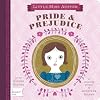
I do not think that Pride and Prejudice and Zombies can top this charming and funny recasting of P&P as a counting book for kids.

So many great stories. "The Fog Horn." "A Sound of Thunder," one of the great time travel and dinosaur stories (the description of the T-Rex is sublime and awesome). "The Murderer," a great prediction of our always in touch world. And so many more.

One of the best sf novels I've ever read. It takes place in Malacia, a city that is an alternate 18th-century Italy where most inhabitants feel protected by their rulers' rejection of social and political change. The story follows Perian, a broke actor, as he cuts across all levels of society as part of a company that is presenting a play using a new process, mercurization, aka photography. This is sf's Candide and a neglected classic. If that isn't enough for you, there is also a dinosaur hunt.
A satire of Hemingway. A nod to Tarzan. A full-speed tearing into the nature of existence. And lions.
Flickers was published in 1995 to commemorate the centenary of cinema. It consists of 100 movie stills, 1 per year from 1895 to 1994, each accompanied by a short essay about the specific film, but more often branching off into considerations of the director, the genre, or cinema as a whole. What immediately attracted me to this book when I saw it on the shelf of the University Co-op bookstore in Austin, Texas, were the profuse illustrations (often a deficiency of books about film), then the fact that some of my personal favorites (Lawrence of Arabia, The Color of Pomegranates, 2001, Black Narcissus, Citizen Kane) were included, and then Adair’s lapidary prose style (which is impossible to boil down to brief extracts, Adair would have never tweeted), coupled with startling judgements (some unusual: an insistence that silent movies should be projected silent, without score) but quite a few that, to my mind, are absolutely correct. For example, on film noir (1956: Beyond a Reasonable Doubt):
“There is, though, a most curious paradox in the film noir. I yield to no one, as they say, in my love for the genre and I recognize the pertinence of much that has been written about its inherent pessimism. Yet I must confess to never having found that pessimism very convincing. No one in the forties ever went to a film noir with a sense that he was about to submit to a harrowing but salutary dose of existential nihilism (a nihilism that isn’t just a matter of critical show more interpretation but is quite perceptible in both narrative detail and visual texture), just as no one ever need recoil from watching one on television now. Films noirs are great fun, for God’s sake, great fun primarily because they never really do persuade one that the despair that they portray is ultimately a truth of the human condition—in the way that, at least while one is experiencing it, a film by Bergman does, or a novel by Kafka, or an opera by Berg. For most of us, I suspect, their fabled negativity is precisely that: a negative (in the photographic sense of the word) of the fundamental American positivity and optimism. The people who made them (and who were usually, as I’ve said, European exiles) loved America, just as did the people who watched them. Secretly, I believe, they were not even meant to convince.”
Since first reading Flickers, I have always turned to it after checking off another of its films that I hadn’t seen before. (And strangely enough, the one film I thought I would never see, Bardelys the Magnificent, which Adair uses as an example of the many lost silent films, was found, and I watched it on TCM.) Flickers reminds me of the old slogan for Jay’s potato chips, “You can’t eat just one.” You cannot just read one line or page. It must be devoured. show less
“There is, though, a most curious paradox in the film noir. I yield to no one, as they say, in my love for the genre and I recognize the pertinence of much that has been written about its inherent pessimism. Yet I must confess to never having found that pessimism very convincing. No one in the forties ever went to a film noir with a sense that he was about to submit to a harrowing but salutary dose of existential nihilism (a nihilism that isn’t just a matter of critical show more interpretation but is quite perceptible in both narrative detail and visual texture), just as no one ever need recoil from watching one on television now. Films noirs are great fun, for God’s sake, great fun primarily because they never really do persuade one that the despair that they portray is ultimately a truth of the human condition—in the way that, at least while one is experiencing it, a film by Bergman does, or a novel by Kafka, or an opera by Berg. For most of us, I suspect, their fabled negativity is precisely that: a negative (in the photographic sense of the word) of the fundamental American positivity and optimism. The people who made them (and who were usually, as I’ve said, European exiles) loved America, just as did the people who watched them. Secretly, I believe, they were not even meant to convince.”
Since first reading Flickers, I have always turned to it after checking off another of its films that I hadn’t seen before. (And strangely enough, the one film I thought I would never see, Bardelys the Magnificent, which Adair uses as an example of the many lost silent films, was found, and I watched it on TCM.) Flickers reminds me of the old slogan for Jay’s potato chips, “You can’t eat just one.” You cannot just read one line or page. It must be devoured. show less

Small monograph about the U.S.S. Alfred, one of America's first ships. I was startled to learn that in 1776 the US briefly invaded Nassau in the Bahamas.
A People Numerous and Armed: Reflections on the Military Struggle for American Independence by John Shy
Fascinating collection of essays about the Revolutionary War that were all written during or just after the Vietnam War. Thus the questions are very interesting. Could the British have won American "hearts and minds"? (Probably not.) Could the Revolution have been averted if the British had been more sympathetic to the Americans. (The British were probably as sympathetic as they were going to be.) The final essay, about the American military experience from colonial days to Vietnam, is thought-provoking and still applicable, I think, post-Iraq.
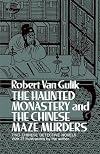
Two books in one of my favorite mystery series, the Judge Dee novels, about a 7th-century Chinese magistrate. Robert van Gulik evokes the setting well. Even though he knew much more about ancient China than the reader, he never pulls a bad sci-fi move such as having the characters tell each other the social context they should already know. Van Gulik was also great at physical settings (here, a 200-year-old monastery during a summer thunderstorm and Lan-fang, a town on the northwest border that the trade route has passed by.)

In the year 2000 (yes, that does seem to be the year this takes place), war has faded from the Earth, and humanity growing ever-closer together is getting ready to explore the rest of the solar system. Humanity doesn't know that one man is responsible. The Anderson Cooper-like Laurent Michaelmas is not only the world's top newsman; he is the man behind the curtain. He has a superintelligent computer, Domino, and together they run everything, gently nudging humankind forward. But when a Swiss doctor announces that he has cured an astronaut thought vaporized in a shuttle explosion, Michaelmas suspects that something alien is behind it. This novel is by turns interesting and half-baked. Much like the action in Lem's The Investigation and the Strugatskys' Definitely Maybe, the conspiracy and Michaelmas-Domino operate through accumulations of slight probabilities, an overheated wire here, an anonymous tip there. But this setup raises many more interesting questions than it answers. Why is Michaelmas running the world? How did he create Domino? The conspiracy plot seems to be a mismatch of ambitious aims with slight means, like trying to destroy the Great Pyramid by sanding it down with a nail file. The minor characters notice something is strange with the world ("like being stuck in Jello"), but the interesting idea that humanity might not really appreciate sidling toward utopia is never really addressed. However... a few days ago, I saw a graph that showed a sharp drop in show more deaths by war since the 1950s. That seemed to me to be a Michaelmas-Domino result. But then there is the recession, where no one's hand seems to be on the tiller at all. Both are equally discomfiting. show less

Judge Dee stops off on the way back from the capital in Paradise Island, a resort town where fleecing the customer through gambling, prostitution, and drink is the main industry. Judge Dee is too upright for any of that, but his friend Magistrate Lo convinces him to stay an extra day to wrap up a routine suicide case. Dee is then confronted by three unexplained deaths over a period of 30 years in the same locked room, the Red Pavilion, the hotel room he is staying in. Science fiction writers can learn much from van Gulik who subtly fills you in on all the alien details of this distant time and place. Conrad is probably the winner when it comes to writing in English as a second language, but van Gulik holds his own. (Like Necklace and Calabash, the influence of Chandler can be seen, particularly in the great supporting characters of the Crab and the Shrimp.)
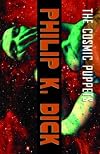
This is Dick's first really good novel (and has a lot of similarities to his first great novel, Time Out of Joint). Ted Barton goes back to his hometown of Millgate, Va., to find it totally changed, with a history where he died at 9, and impossible to escape. This was written in 1957, which feels like a surprising milieu for PKD with its rundown small town and Ted driving around in a Packard. In a much cooler alternate universe, this would have made into a movie in 1957. With Dana Andrews as Ted and directed by Jacques Tourneur. The culture would have had a total freakout.
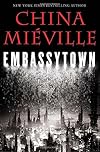
One of the best science fiction novels I've ever read. I've gone through a bit of a doldrums with sf with some recent books (a few award-winners), failing to live up to their expectations. However, if Mieville's other books are one-tenth as good as this, he more than deserves his acclaim. This gives me hope that sf is not tapped out.

In the future year of 1904, an impoverished English inventor solves the secret of aerial navigation. He hands it over to the nihilist organization, the Terrorists, dedicated to the overthrow of capitalism and militarism. This starts out as pretty poor sf, much below what Wells was doing, but it builds up to a harrowing depiction of a vast, apocalyptic total world war, which prefigures World War I with the unusual wrinkle of the UK and Germany fighting against Russia and France. For fans of Michael Moorcock, this seems to be one of the influences behind the Bastable novels, but I think it's better since this is the pure source.
I decided to revisit Holmes after watching the excellent new BBC update. Still as good as I remember. I didn't notice till now however that 3 cases have the same motive.

Ballard's final book, alas. Quite a bit different than his fictional autobiography, Empire of the Sun and The Kindness of Women. Some details that stick out in my mind: He was the most radical of the New Wavers but didn't partake of 1960s craziness because he was raising 3 kids as a single dad. He did indeed have a grand old time in the Japanese interment camp, where one of the other kids was future cult TV actor Peter Wyngarde.

Great return to form after the doldrums of The Ionian Mission. Two bits that I love: "the city of Valetta was as cheerful as though it were fortunate in love or as though it had suddenly heard good news." And Captain Aubrey looking through the stern-window: "This was a sight that never failed to move him: the noble curve of shining panes, wholly unlike any landborne window, and then the sea in some one of its infinity of aspects; and the whole in silence, entirely to himself. If he spent the rest of his life on half-pay in a debtors' prison he would still have had this, he reflected, eating the last of the Cephalonian cheese; and it was something over and above any reward he could have possibly contracted for." Quibble: I think Stephen should have figured out the double agent pretty quickly.

Average entry in the Judge Dee series. Unfortunately resorts to Judge Dee putting visiting the person who knows who the murderer is last on his to-do list. Does have great ending.

One of the best of the series, and the most like a Chandler novel. You wouldn't think one could do the scene where the detective is told to just shut up and get in the car in the 7th century, but van Gulik pulls it off.

One of the weaker Judge Dee novels, with a muddled, confusing mystery. However, the scene where Judge Dee tells who did it is great.

Another solid Judge Dee Mystery. This time, he, Ma Joong, and Sergeant Hoong investigate three cases, with the main setting being a deserted temple. (There are quite a few deserted temples in Van Gulik.)

Solid Judge Dee mystery about three cases in the plague-stricken imperial capital. I think he solves one of the mysteries too easily, but there are cool things such as the art of "loaded sleeves."

Basically Howard's take on Edgar Rice Burroughs' Barsoom series. Pretty routine.

I liked this better than the movie, because England in the book is still pretty grim, but it's from humanity winding down rather than the Mad Max craziness of the film. (The film really borrows only the basic premise and the character names.) Speaking of casting, the Theo of the book seems more Steve Coogan than Clive Owen.

Undecided now whether this or Pride and Prejudice is Austen's best. Might have been more forceful if I hadn't read it over a period of weeks. Also, the Penguin Classic has the most ridiculous and pedantic footnotes. "Late: recent" You don't say.
Wow. Where has this been my whole life? I still have a lot more to read, but this may be the greatest American novel. Rich in language, but tight in construction. My sister said this was what an American Dostoyevsky would have been like, and I agree with her. This is one of the most intense novels about sin, guilt, and redemption, that is, about things that really matter.

Wow. Where has this been my whole life? I still have a lot more to read, but this may be the greatest American novel. Rich in language, but tight in construction. My sister said this was what an American Dostoyevsky would have been like, and I agree with her. This is one of the most intense novels about sin, guilt, and redemption, that is, about things that really matter.

This was pretty painful to start with since it seemed like Wilde could not resist a zinger. The first chapters with Wotton are like Monty Python's Oscar Wilde sketch. However, once Gray sees the first change in the portrait, the novel becomes a ruthless criticism of everything. Wilde does not even spare himself. The descriptive passages of London at night and the interior decor are quite lush. (Also, it amazes me that people were sufficiently in awe of Huysman's Against Nature that it could be posited as morally poisoning a reader.) This is a variation on Dostoyevsky's if God does not exist, everythng is permitted. If one does not age, then one will act like everything is permitted. Wilde shows, however, that the cult of Art (for which he bore some responsibility) can never be a foundation for a right existence. Everything will pass. What does not? What should remain?
Three things about The Iliad.
1. There are quite a few metaphors about lions, who either kill cattle or sheep or are hunted in turn. 3,000 years ago Greece was overrun with lions.
2. It's interesting that one of the first long narratives in human has no suspense. The sack of Troy is a foregone conclusion. Even Achilles knows his fate.
3. I read Fagles' translation. I love it, but I think Fitzgerald is slightly better at conveying the strangeness of this world even if that does lead him astray sometimes.
1. There are quite a few metaphors about lions, who either kill cattle or sheep or are hunted in turn. 3,000 years ago Greece was overrun with lions.
2. It's interesting that one of the first long narratives in human has no suspense. The sack of Troy is a foregone conclusion. Even Achilles knows his fate.
3. I read Fagles' translation. I love it, but I think Fitzgerald is slightly better at conveying the strangeness of this world even if that does lead him astray sometimes.
I always thought this was an amazing book until it fell apart in the last few chapters, but I think I finally figured out what Twain was doing. The book is about lies and a society of lies, with slavery the biggest lie of all. Also, I love the bits when they're just floating down the river.