
Richard P. Feynman (1918–1988)
Author of Surely You're Joking, Mr. Feynman! Adventures of a Curious Character
Richard P. Feynman is Richard Feynman (1). For other authors named Richard Feynman, see the disambiguation page.
Series
Works by Richard P. Feynman
Surely You're Joking, Mr. Feynman! Adventures of a Curious Character (1985) — Author — 10,980 copies, 200 reviews
Six Easy Pieces: Essentials of Physics Explained by Its Most Brilliant Teacher (1963) 4,490 copies, 45 reviews
"What Do You Care What Other People Think?": Further Adventures of a Curious Character (1988) 3,905 copies, 59 reviews
Six Not-So-Easy Pieces: Einstein's Relativity, Symmetry, And Space-Time (1963) 1,730 copies, 10 reviews
Perfectly Reasonable Deviations from the Beaten Track: The Letters of Richard P. Feynman (2005) 1,135 copies, 19 reviews
The Feynman Lectures on Physics, Vol. 1: Mainly Mechanics, Radiation, and Heat (1963) 1,068 copies, 5 reviews
The Feynman Lectures on Physics, Vol. 2 : Mainly Electromagnetism and Matter (1964) — Author — 911 copies, 2 reviews
The Feynman Lectures on Physics: The Complete Audio Collection, Volume 1: Quantum Mechanics (1968) 26 copies
The Feynman Lectures on Physics: The Complete Audio Collection, Volumes 1-2 (2003) — Narrator, some editions — 25 copies
Selected Papers of Richard Feynman: With Commentary (World Scientific Series in 20th Century Physics) (2000) 21 copies
The Feynman Lectures on Physics: The Complete Audio Collection, Volume 11: Science and Vision (2001) 11 copies
The Feynman Lectures on Physics: The Complete Audio Collection, Volume 16: Electromagnetism (2002) 11 copies
The Feynman Lectures on Physics: The Complete Audio Collection, Volume 2: Advanced Quantum Mechanics (1968) 11 copies
The Feynman Lectures on Physics: The Complete Audio Collection, Volume 9: Basic Concepts in Classical Physics (2000) — Author — 11 copies
The Feynman Lectures on Physics: The Complete Audio Collection, Volume 3: From Crystal Structure to Magnetism (1999) 10 copies
The Feynman Lectures on Physics: The Complete Audio Collection, Volume 10: Basic Concepts in Quantum Physics (2000) 9 copies
The Feynman Lectures on Physics: The Complete Audio Collection, Volume 4: Electrical and Magnetic Behavior (1999) 9 copies
The Feynman Lectures on Physics: The Complete Audio Collection, Volume 14: Electricity and Magnetism, Part 1 (2001) 8 copies, 1 review
The Feynman Lectures on Physics: The Complete Audio Collection, Volume 17: Electrodynamics (2002) 8 copies
The Feynman Lectures on Physics: The Complete Audio Collection, Volume 15: Electricity and Magnetism, Part 2 (2002) 8 copies
The Feynman Lectures on Physics: The Complete Audio Collection, Volume 6: Electrical and Magnetic Behavior (1999) 8 copies
The Feynman Lectures on Physics: The Complete Audio Collection, Volume 5: Energy and Motion (1999) 7 copies
The Feynman Lectures on Physics: The Complete Audio Collection, Volume 20: The Very Best Lectures (2003) 7 copies, 2 reviews
La fisica di Feynman. Ediz. italiana e inglese vol. 4 - Consigli per risolvere i problemi di fisica (2007) 7 copies
The Feynman Lectures on Physics: The Complete Audio Collection, Volume 19: Masers and Light (2003) 5 copies
The Feynman Lectures on Physics: The Complete Audio Collection, Volumes 9-10 (2007) — Author — 4 copies
La nature des lois physiques 3 copies
Symmetries in elementary particle physics : 1964 International School of Physics "Ettore Majorana," a CERN-MPI-NATO Advanced Study Institute (2013) 3 copies
UMA TARDE COM O SR. FEYNMAN Introdução, apresentação, notas e tradução de A.M. Nunes dos Santos e C. Auretta (2023) 3 copies
Los Alamos From Below 3 copies
A Feynman-előadások fizikából IV. 2 copies
Genius 1 copy
Mai fizika 6 : Elektromágneses indukció : Maxwell-egyenletek : Relativisztikus elektrodinamika 1 copy
Exercises and Solutions for Richard Feynman Lectures on Physics - Volumes I, II, and III (1964) 1 copy
No Ordinary Genius (Text adapted from the Horizon program transmitted 25 January 1993) - Parts 1 & 2 1 copy
Feynman Vorlesungen über Physik. Band I Mechanik Strahlung Wärme Teil 2 (Vorlesungen über Physik) (1973) 1 copy
What Is Science? 1 copy
Optika anyaghullámok 1 copy
La Fisica di feynman. Volume I, Parte 2. Principalmente sulla meccanica, radiazione e calore (1975) 1 copy
La Fisica di feynman. Volume II, Parte 1. Principalmente elettromagnetismo e struttura della materia (1985) 1 copy
Associated Works
Feynman Lectures on Physics: Exercises (1964), Volume 2 (1964) — Original textbook author — 15 copies
Feynman Lectures on Physics: Exercises, Volume 1 (1964) — Original textbook author — 13 copies, 1 review
Tagged
Common Knowledge
- Canonical name
- Feynman, Richard P.
- Legal name
- Feynman, Richard Phillips
- Birthdate
- 1918-05-11
- Date of death
- 1988-02-15
- Gender
- male
- Education
- Massachusetts Institute of Technology (BS)
Princeton University (PhD) - Occupations
- professor
theoretical physicist - Organizations
- Manhattan Project
Cornell University
California Institute of Technology
Rogers Commission - Awards and honors
- Albert Einstein Award (1954)
E. O. Lawrence Award (1962)
Nobel Prize (Physics, 1965)
Royal Society (Foreign Member, 1965)
National Medal of Science (1979) - Short biography
- [from official website]
Richard Phillips Feynman was born in New York City in 1918 and grew up in Far Rockaway, Queens. He attended the Massachusetts Institute of Technology as an undergraduate, and he received his Ph.D. from Princeton University. In 1942 he married his high school sweetheart, Arline Greenbaum, despite the fact that she was ill with tuberculosis. That same year Richard was asked to join the Manhattan Project; he accepted and went on to become a group leader at Los Alamos, New Mexico. Arline died in 1945. After the war, he became a professor of theoretical physics at Cornell University in Ithaca, New York. In 1950 he joined the faculty of the California Institute of Technology and spent the remainder of his career there. He had a brief marriage in the early fifties to Mary Louise Bell that did not work out. He married Gweneth Howarth in 1960. Their son Carl was born in 1962, and their daughter Michelle was born in 1968.
Many consider him to be the father of nanotechnology for two prizes he offered in a 1959 talk entitled, “There's Plenty of Room at the Bottom,” where he prompted thinking on a very small scale. He offered a prize for the world's smallest motor, and another challenge involving very small writing; so small that the text of the Encyclopedia Britannica could be contained on the head of a pin. The prize for the motor was claimed almost immediately, but the challenge of the writing wasn't met for over 20 years. Between 1961-3 Feynman gave a series of lectures on introductory physics for freshmen and the following year, sophomores, at Caltech. The series was edited and published as The Feynman Lectures of Physics, which is thought to be the most popular physics book ever written.
His most public achievement came in 1965, when he won the Nobel Prize in Physics, sharing it with Julian Schwinger and Shin'ichiro Tomonaga for their independent work in quantum electrodynamics. In 1986, he was again in the public eye, this time working on the commission investigating the explosion of the Challenger space shuttle. He died in 1988 after a long battle with abdominal cancer. - Cause of death
- cancer
- Nationality
- USA
- Birthplace
- New York, New York, USA
- Places of residence
- Far Rockaway, Queens, New York, New York, USA
Los Alamos, New Mexico, USA
Ithaca, New York, USA
Pasadena, California, USA - Place of death
- Los Angeles, California, USA
- Burial location
- Mountain View Cemetery and Mausoleum, Altadena, California, USA
- Map Location
- New York, USA
Members
Discussions
Feynman in Legacy Libraries (March 2021)
Reviews
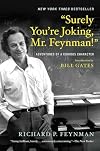
When I conjure a Nobel Laureate in physics in my mind’s eye, some very definite attributes emerge. I think of a man, yes, a man, because my inner Papaw is stuck in 1915. I think of someone who worked on the Manhattan project alongside some of the greatest minds in history. In addition to teaching at one of the world’s most preeminent institutions in his field, I see a professor who is also a failed poet. But someone whose drawings were good enough to hang in some of California’s finest show more brothels and showed some talent playing drums. Luncheoning four or five times a week at a nearby topless bar because that is the one place where a Nobel Prize winner is left alone and able to focus on his work, he holds little regard for convention. (The boobies are just a bonus.) Lastly, I envision someone whose curiosity is the one thing that shines almost as brightly as the universe he studies. I think of Richard P. Feynman, Ph.D. At least I do now after finishing “Surely You’re Joking, Mr. Feynman.” show less
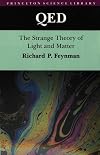
This weekend just passed my flatmate's boyfriend was visiting. Being the inquisitive sort, at one point he asked me if I could explain the main results of my PhD thesis to him in terms he would understand. To my eternal shame my knee-jerk response was "No." But a few moments later I was to be found scrawling on a napkin, explaining rational points on curves, density arguments, counting functions, and concluding by using the word "generalise" far more times in one sentence than I was show more comfortable with.
He seemed to follow my haphazard ramblings which is always enough to leave one chuffed. It's no secret to the science community that its biggest failing is an inability to communicate with and engage the public. The more esoteric the science, the trickier it is to convey it in terms that are both accurate and interesting. And, outside of pure mathematics, it doesn't get a great deal more esoteric than quantum mecahnics. So Richard Feynman's QED is laudable for, if nothing else, being about as understandable as is possible with this subject. There were times that the text lost me, but after giving it some thought I realised in each case that it was because I was expecting the quantum world to make sense, and to paraphrase my old Physics teacher: if quantum mechanics starts making sense, then you've stopped understanding it.
Feynman's abilities as a scientific orator are pretty well known—one of my favourite videos on Youtube is a two-and-a-half minute video of Feynman sitting in a chair explaining how a train stays on the tracks. Seriously. Feynman's writing skills are apparently just as good, but I've not read any of his other books and this one is actually the edited transcriptions of four of his lectures, so his speaking prowess proves more useful here. And as if being fascinating, self-deprecating, and witty wasn't enough, he also manages to be quite touching. The lectures were the inaugural set in a series dedicated to Alix Mautner, an English major and long time friend of Feynman to whom the physicist had promised to explain quantum electrodynamics in terms she could understand. Sadly she died before he managed to do so, but the lectures here are, as he says, the ones he prepared for Alex, but that he could no longer give just to her. show less
He seemed to follow my haphazard ramblings which is always enough to leave one chuffed. It's no secret to the science community that its biggest failing is an inability to communicate with and engage the public. The more esoteric the science, the trickier it is to convey it in terms that are both accurate and interesting. And, outside of pure mathematics, it doesn't get a great deal more esoteric than quantum mecahnics. So Richard Feynman's QED is laudable for, if nothing else, being about as understandable as is possible with this subject. There were times that the text lost me, but after giving it some thought I realised in each case that it was because I was expecting the quantum world to make sense, and to paraphrase my old Physics teacher: if quantum mechanics starts making sense, then you've stopped understanding it.
Feynman's abilities as a scientific orator are pretty well known—one of my favourite videos on Youtube is a two-and-a-half minute video of Feynman sitting in a chair explaining how a train stays on the tracks. Seriously. Feynman's writing skills are apparently just as good, but I've not read any of his other books and this one is actually the edited transcriptions of four of his lectures, so his speaking prowess proves more useful here. And as if being fascinating, self-deprecating, and witty wasn't enough, he also manages to be quite touching. The lectures were the inaugural set in a series dedicated to Alix Mautner, an English major and long time friend of Feynman to whom the physicist had promised to explain quantum electrodynamics in terms she could understand. Sadly she died before he managed to do so, but the lectures here are, as he says, the ones he prepared for Alex, but that he could no longer give just to her. show less
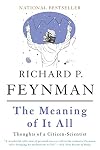
I like the way Feynman thought about things and explained his thoughts. In these three lectures he rambles a bit as always and, as always, addresses certain themes that he would keep on addressing. I think there are three kinds of Feynman writings: the recounted anecdotes about himself; his more serious essays, talks, and interviews; and his serious books about science. As I have gotten older I've tended to like the anecdotes less, and the rest more. Of course, there is some overlap in this show more one.
Feynman is often characterized as irreverent and I think he was; what he wasn't was automatically disrespectful of or insulting to things and people. Lawrence Krause seems to think he has inherited the Feynman mantle and wishes to appear to be similarly irreverent, but he is mostly smug, dismissive, and bigoted, instead. Irreverence is just not what it used to be, I guess. show less
Feynman is often characterized as irreverent and I think he was; what he wasn't was automatically disrespectful of or insulting to things and people. Lawrence Krause seems to think he has inherited the Feynman mantle and wishes to appear to be similarly irreverent, but he is mostly smug, dismissive, and bigoted, instead. Irreverence is just not what it used to be, I guess. show less

Reminiscences, rather than memoirs, obviously transcribed from audio recordings and rather rambling and peppered with exclamation marks as a result — all the anecdotes implicitly either end in "look how clever I was!" or "...and look what a mess it got me into!" But of course it's very interesting because of who it is. You pretty much have to forgive him for revelling in his own cleverness. After all, if theoretical physicists aren't allowed to cleverer than the rest of us, then it's show more probably a poor look-out for the world...
Feynman tells us about his childhood teaching himself how to mend wireless sets in Far Rockaway (apparently without electrocuting himself or starting any fires he couldn't extinguish), his student days at MIT trying to learn the social conventions of college life by experiment and rational enquiry, his time at Los Alamos (where we hear essentially nothing about atomic bombs and a lot about lock-picking, drumming, and fights with base security), his experimental approach to responsible adult life (most experiments mainly involved sitting in bars picking up girls), unexpected disadvantages of winning the Nobel Prize, the idiocies of school textbooks, more drumming, idiocies of Californian Cargo Cult Science, and learning to draw (...naked women). Often very funny, although, inevitably, not all the jokes are as funny as they were when he first told those anecdotes, or indeed as funny on the printed page as they would have been when he told them in person.
It did make me wonder how many perfectly competent nerds of my generation were lost to science because we realised we could never hope to be anywhere near as cool as Feynman...
(Unfortunately, this Norton paperback (rebound by the library) turned out to be just as over-busy in its internal layout as that terrible front cover. The 80s and 90s in the US were not a good time for book-design — people were still learning what not to do with computer typesetting, I suppose.) show less
Feynman tells us about his childhood teaching himself how to mend wireless sets in Far Rockaway (apparently without electrocuting himself or starting any fires he couldn't extinguish), his student days at MIT trying to learn the social conventions of college life by experiment and rational enquiry, his time at Los Alamos (where we hear essentially nothing about atomic bombs and a lot about lock-picking, drumming, and fights with base security), his experimental approach to responsible adult life (most experiments mainly involved sitting in bars picking up girls), unexpected disadvantages of winning the Nobel Prize, the idiocies of school textbooks, more drumming, idiocies of Californian Cargo Cult Science, and learning to draw (...naked women). Often very funny, although, inevitably, not all the jokes are as funny as they were when he first told those anecdotes, or indeed as funny on the printed page as they would have been when he told them in person.
It did make me wonder how many perfectly competent nerds of my generation were lost to science because we realised we could never hope to be anywhere near as cool as Feynman...
(Unfortunately, this Norton paperback (rebound by the library) turned out to be just as over-busy in its internal layout as that terrible front cover. The 80s and 90s in the US were not a good time for book-design — people were still learning what not to do with computer typesetting, I suppose.) show less
Lists
Overdue Podcast (1)
Read This Next (1)
Folio Society (1)
Unread books (1)
BusinessBooks (1)
Physics (2)
My wishlist (1)
Awards


You May Also Like
Associated Authors
Statistics
- Works
- 153
- Also by
- 8
- Members
- 41,526
- Popularity
- #419
- Rating
- 4.2
- Reviews
- 520
- ISBNs
- 764
- Languages
- 25
- Favorited
- 5


