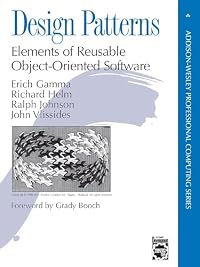
Design Patterns: Elements of Reusable Object-Oriented Software
by Erich Gamma (Author), Richard Helm (Author), Ralph E. Johnson (Author), John M. Vlissides (Author)
On This Page
Description
Four software designers present a catalog of simple and succinct solutions to commonly occurring design problems, using Smalltalk and C++ in example code. These 23 patterns allow designers to create more flexible, elegant, and ultimately reusable designs without having to rediscover the design solutions themselves. The authors begin by describing what patterns are and how they can help you design object-oriented software. They go on to systematically name, explain, evaluate, and catalog show more recurring designs in object-oriented systems.--From publisher description. show lessTags
Recommendations











Member Reviews
If there were required reading mandated for any degree involving computer software development, this would be it.
Gamma, et al (AKA The Gang of Four) have given us a comprehensive guide to various software patterns, and it's the least we could do to follow them.
It discourages me to see and hear about professional industries making lousy software that can't communicate with other tools, even those made by the same vendor. It bothers me when there are tools out there that make use of a network connection, but apparently don't play nicely with people using other operating systems or even other interfaces. Why can't I play Scrabble on my iPhone with someone using Facebook's Scrabble app? Why can't I play a co-op game of LittleBigPlanet on my show more PSP with another user playing on a PS3?
Well, the short answer is that you should be able to do these things, using interfacing, one of the fundamental patterns in this book. Just as the user (usually) doesn't care what's going on behind the curtain with their software applications, as long as they get the right feedback when the click the right buttons, the client-side application shouldn't care about what's going on in the server-side, as long as it gets the right feedback from the server when it sends it the right data. When you hear things like this for the first time, it's kind of eye-opening, but at the same time, when you think about it for a minute, it really makes sense. It's like when you're playing a puzzler game, and you need a hint about how to solve a puzzle; once you see the solution, you smack your head. "That's makes so much sense!" you say, "Why didn't I think of that." Well, consider this book the solution guide to software design.
No, it's not a recipe book (like the O'Reilly Cookbook series), but it does provide examples of the patterns you should be using, and unless you describe your coding style as "anarchist," it should really help you.
If you're a software engineer and get your hands dirty by mucking with software, and you haven't yet read this book, then take off those coding gloves and give yourself about a week to absorb the amazing knowledge this book presents. If you want to go into software engineering, ensure that you have a firm grasp of a particular programming language, and then read this book, preferably before you start interviewing for a job. Then, in your interview, when asked a technical question, you can start off your answer by saying, "Well, The Gang of Four said in their book on design patterns..." And then, you're working in some software engineering field (results may vary).
If you're truly devoted to making yourself a better software engineer, though, you simply must read this book. show less
Gamma, et al (AKA The Gang of Four) have given us a comprehensive guide to various software patterns, and it's the least we could do to follow them.
It discourages me to see and hear about professional industries making lousy software that can't communicate with other tools, even those made by the same vendor. It bothers me when there are tools out there that make use of a network connection, but apparently don't play nicely with people using other operating systems or even other interfaces. Why can't I play Scrabble on my iPhone with someone using Facebook's Scrabble app? Why can't I play a co-op game of LittleBigPlanet on my show more PSP with another user playing on a PS3?
Well, the short answer is that you should be able to do these things, using interfacing, one of the fundamental patterns in this book. Just as the user (usually) doesn't care what's going on behind the curtain with their software applications, as long as they get the right feedback when the click the right buttons, the client-side application shouldn't care about what's going on in the server-side, as long as it gets the right feedback from the server when it sends it the right data. When you hear things like this for the first time, it's kind of eye-opening, but at the same time, when you think about it for a minute, it really makes sense. It's like when you're playing a puzzler game, and you need a hint about how to solve a puzzle; once you see the solution, you smack your head. "That's makes so much sense!" you say, "Why didn't I think of that." Well, consider this book the solution guide to software design.
No, it's not a recipe book (like the O'Reilly Cookbook series), but it does provide examples of the patterns you should be using, and unless you describe your coding style as "anarchist," it should really help you.
If you're a software engineer and get your hands dirty by mucking with software, and you haven't yet read this book, then take off those coding gloves and give yourself about a week to absorb the amazing knowledge this book presents. If you want to go into software engineering, ensure that you have a firm grasp of a particular programming language, and then read this book, preferably before you start interviewing for a job. Then, in your interview, when asked a technical question, you can start off your answer by saying, "Well, The Gang of Four said in their book on design patterns..." And then, you're working in some software engineering field (results may vary).
If you're truly devoted to making yourself a better software engineer, though, you simply must read this book. show less
Depending on on how you think of programming, this book could be incredibly insightful, or horribly abstract and impractical. Since I prefer and tend to think in patterns and abstractions, I found this book close to my heart. It uses a variety of languages for examples, so a willingness to explore concepts, not practical solutions, is essential.
Design Patterns is a very important reference and its contents are also important, but it is a rather dull book to read. This is mainly because the bulk of the book contains a catalog of patterns. Like most catalogs, it works better when you come to it looking for something specific.
I have two main criticisms of the patterns themselves, both of which stem more from the time the book was written than from any inherent problems with the patterns. First, each pattern contains a list of benefits and consequences. This section never considers the pattern from the view point of testability. This is a pity because most of the patterns, in my opinion, serve to make the relevant components easier to test.
A more serious complaint is that many of show more the patterns show their age by suggesting implementation inheritance as a good way of implementing these patterns. While implementation inheritance still has its place in the programmer's toolbox, current wisdom shies away from using it merely because it is convenient. Instead, current belief leans more toward preferring interfaces (in the Java sense of only defining operations and not implementations) and reserves implementation inheritance for when it provides a tangible benefit.
That said, most of the patterns still have a useful core, even if some of the details of pattern structure or implementation should be modified to fit better into common practice. Just remember though, if you want to read through it you need will power or a reading group (preferably both). show less
I have two main criticisms of the patterns themselves, both of which stem more from the time the book was written than from any inherent problems with the patterns. First, each pattern contains a list of benefits and consequences. This section never considers the pattern from the view point of testability. This is a pity because most of the patterns, in my opinion, serve to make the relevant components easier to test.
A more serious complaint is that many of show more the patterns show their age by suggesting implementation inheritance as a good way of implementing these patterns. While implementation inheritance still has its place in the programmer's toolbox, current wisdom shies away from using it merely because it is convenient. Instead, current belief leans more toward preferring interfaces (in the Java sense of only defining operations and not implementations) and reserves implementation inheritance for when it provides a tangible benefit.
That said, most of the patterns still have a useful core, even if some of the details of pattern structure or implementation should be modified to fit better into common practice. Just remember though, if you want to read through it you need will power or a reading group (preferably both). show less
A classic in the field of computer science, this book describes how object-oriented software can be used to develop meaningful (and reusable) classes. It is written by the so-called "gang of four" affiliated with a working group at the University of Illinois. It has achieved notoriety for its assistance in helping programmers write code more effectively in languages like C , SmallTalk, and (my current language) PHP. The book has started a large movement in identifying design principles that are inherent in all computer science problems.
The book reads like a catalog of class types. After an initial critique on the state of computer programming, it reads like a textbook and a reference manual to be used. It is academic, analytical, and show more brilliant. Obviously, the book is only for the serious programmer who aspires to master her/his trade. It is not for the casual programmer or even for the intermediate programmer. It does not hold the reader's metaphorical hand as the book is perused. Instead, it provides data and analysis like a research paper. Of course, in such a style, wisdom is distilled into compact sentences.
I'll be happy to put this book on my bookshelf at work and refer to it when designing software. show less
The book reads like a catalog of class types. After an initial critique on the state of computer programming, it reads like a textbook and a reference manual to be used. It is academic, analytical, and show more brilliant. Obviously, the book is only for the serious programmer who aspires to master her/his trade. It is not for the casual programmer or even for the intermediate programmer. It does not hold the reader's metaphorical hand as the book is perused. Instead, it provides data and analysis like a research paper. Of course, in such a style, wisdom is distilled into compact sentences.
I'll be happy to put this book on my bookshelf at work and refer to it when designing software. show less
This book was really a game-changer. The art of creating a computer program had not been analyzed much at all up until that point - plenty of algorithms had been created by computer scientists, and systems designers had some ideas about API's, but there wasn't a whole lot of direction for people who wanted to engineer applications to do things that user wanted them to do. Some of the patterns in the book are in common use today; others have been relegated to the dustbin; but the larger point is that after this book came out, people started using a whole new language to describe the work they were doing. Today we have UI patterns, management patterns, data access patterns, antipatterns, patterns, patterns, patterns everywhere, and this show more was the book that really caused the concept to take off.
Is it worth reading today? That's a little tougher. There's no question to my mind that every developer should be familiar with the patterns in this book, but a more modern book on the same topic would probably display source code in a language that more people would more commonly be using. Still, there's no question that if you want to go back to the basics, you go back to Gamma. show less
Is it worth reading today? That's a little tougher. There's no question to my mind that every developer should be familiar with the patterns in this book, but a more modern book on the same topic would probably display source code in a language that more people would more commonly be using. Still, there's no question that if you want to go back to the basics, you go back to Gamma. show less
A classic for OOP - not much else to say: You've got to read it, if only to say you read it :-) True, the book is C++ focused (it will be somewhat tough for those who only know Java / C#) and it has quite a level of sophistication (probably aimed at those in a Computer Science degree or master's programs). But, that said, it really started a big part of the revolution in OO - open source gave us reusable code, design patterns gave us reusable solutions to design problems; and this was the book that really "lit the fire" for patterns.
Perhaps more referenced than read...that's certainly the case for me. I've never tried to implement one of these things, but every once and a while I skim the patterns and it's useful to have the ideas filed away.
Members
- Recently Added By
Lists

Books Read in 2017
4,248 works; 129 members

Books Read in 2024
4,623 works; 126 members
Author Information


Some Editions
Series
Belongs to Publisher Series
Common Knowledge
- Canonical title
- Design Patterns: Elements of Reusable Object-Oriented Software
- Original publication date
- 1994; 1997 (CDROM) (CDROM)
- First words
- Designing object-oriented software is hard, and designing reusable object-oriented software is even harder.
- Blurbers
- Wirfs-Brock, Rebecca J.; Vinoski, Steve
Classifications
- Genres
- Technology, Nonfiction, General Nonfiction
- DDC/MDS
- 005.12 — Computer science, information & general works Computer science, knowledge & systems Software development, software, data, security Software development Software systems analysis and design
- LCC
- QA76.64 .D47 — Science Mathematics Mathematics Instruments and machines Calculating machines Electronic computers. Computer science
- BISAC
Statistics
- Members
- 3,626
- Popularity
- 4,452
- Reviews
- 25
- Rating
- (4.12)
- Languages
- 12 — Chinese, Dutch, English, Finnish, French, German, Hungarian, Italian, Japanese, Portuguese, Russian, Spanish
- Media
- Paper, Ebook
- ISBNs
- 37
- UPCs
- 2
- ASINs
- 10