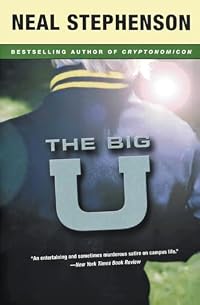
The Big U
by Neal Stephenson
On This Page
Description
The New York Times Book Review called Neal Stephenson's most recent novel "electrifying" and "hilarious". but if you want to know Stephenson was doing twenty years before he wrote the epic Cryptonomicon, it's back-to-school time. Back to The Big U, that is, a hilarious send-up of American college life starring after years our of print, The Big U is required reading for anyone interested in the early work of this singular writer.Tags
Recommendations



Member Recommendations
themulhern At least two characters in the novel have been given the names of the Roman emperors Pertinax and Septimius Severus. This has meaning within the framework of the novel.
themulhern "The Big U" has a note about "The Origin" at the front and a plot influenced by the ideas.
Member Reviews
This was Neal Stephenson's first published novel (1984), written when he was 25 and just out of university. It is an accomplished over-the-top satire on the American university system that reminded me of J. G Ballard's dystopian 'High Rise' of 1975.
It is also the work of a bright young writer from a scientific and rationalist background letting off steam about the insanity and absurdity of the human species when it is purporting to use higher education for improvement but is doing nothing of the kind.
The idea of a modern architectural and institutional structure literally collapsing under its weight because of the raw human nature it seeks to contain is not original but what Stephenson does is make that raw nature the tribalism and show more conformity of American High School culture.
The theme is of often slightly mad (Stephenson makes use of the informal British word 'bonkers' at one point) individualistic heroes triumphing over the mindlessness of people who go to university not to think and learn but to continue their adolescence before they join conventional society.
It is not a great book, just a good one. Sometimes Stephenson lets his own rioting imagination sink into moments of obscurity or incoherence. But there are many moments of hilarity and even filmic excitement as this structure of competing conformities degenerates into violence and outright war.
I could spend paragraphs outlining all the standard tropes of social criticism he makes use of and makes fun of. The final stance is, of course, precisely that of the American liberal rationalist using science to conquer, in part by employing irrational religious enthusiasm against itself.
There is nothing philosophically new in this. It is all part of a liberal intellectual disdain for the mob and, to be unkind, a projection of the impotence felt by the rational individualist (who ironically 'conforms' to his own intolerant stereotype in this respect) in the face of mass society.
This is a book of class war, or rather of class propaganda, directed by one element of society - the technocracy - against the rest of humanity. The author is spokesperson for a rational elite despising the raw material which it has been tasked with overseeing using its own form of 'magic'.
The MegaUniversity becomes a dysfunctional whole, part of a wider society, yet separate from it. Stephenson intensifies its absurdities, viciousness, ignorance (ironically) and chaos. The cement to the story is a completely potty conspiracy theory over control of nuclear waste disposal.
He cites the bicameral brain theory of Jaynes more than once (not a theory I ever found persuasive) but this enables him to play with the idea (especially through the character of the insane Fred Fine) of the two worlds of reason and imagination losing their boundaries.
One of the charms of the book is its contemporary portrayal of the mind-set of the geeks and nerds (evidently one of the sets of hero that mirror the mind of the author) who would come to create our own digital and internet culture over subsequent decades.
It also fair-minded. This is no rant, in fact. The logic of capitalism is cynically argued and the University President SS Krupp, is presented more favourably than any of the social justice warriors avant la lettre of the Stalinist SUB. Indeed, Stephenson clearly quite likes intelligent authority.
Stephenson is also a sensible feminist able to have an easy laugh at the mother goddess types and the airheads but rightly horrified at the collusion of airheads in the exploitative sexual behaviour of MegaUniversity's jocks, curiously self-naming themselves the Terrorists.
The strongest character of all is in fact the lesbian former Student Government head Sarah, a high-achieving, grounded, brave young woman in despair at the conformity of the airheads in her Tower. She is central to the eventual co-operative triumph of reason over hysteria.
There are live action dungeons and dragons-type adventures in sewers, a clown corpse straight out of King horror, inept academics, gunfights in corridors and elevator shafts, a mad former College President stalking the university, electrocutions, bureaucracy and more, much much more.
There is too much to comment on in this book which has everything from giant radioactive rats to murderous food fights. It should just be enjoyed as a romp through American social behaviours with an inventive idea on almost every page and rather likeable gun-toting student heroes and heroines. show less
It is also the work of a bright young writer from a scientific and rationalist background letting off steam about the insanity and absurdity of the human species when it is purporting to use higher education for improvement but is doing nothing of the kind.
The idea of a modern architectural and institutional structure literally collapsing under its weight because of the raw human nature it seeks to contain is not original but what Stephenson does is make that raw nature the tribalism and show more conformity of American High School culture.
The theme is of often slightly mad (Stephenson makes use of the informal British word 'bonkers' at one point) individualistic heroes triumphing over the mindlessness of people who go to university not to think and learn but to continue their adolescence before they join conventional society.
It is not a great book, just a good one. Sometimes Stephenson lets his own rioting imagination sink into moments of obscurity or incoherence. But there are many moments of hilarity and even filmic excitement as this structure of competing conformities degenerates into violence and outright war.
I could spend paragraphs outlining all the standard tropes of social criticism he makes use of and makes fun of. The final stance is, of course, precisely that of the American liberal rationalist using science to conquer, in part by employing irrational religious enthusiasm against itself.
There is nothing philosophically new in this. It is all part of a liberal intellectual disdain for the mob and, to be unkind, a projection of the impotence felt by the rational individualist (who ironically 'conforms' to his own intolerant stereotype in this respect) in the face of mass society.
This is a book of class war, or rather of class propaganda, directed by one element of society - the technocracy - against the rest of humanity. The author is spokesperson for a rational elite despising the raw material which it has been tasked with overseeing using its own form of 'magic'.
The MegaUniversity becomes a dysfunctional whole, part of a wider society, yet separate from it. Stephenson intensifies its absurdities, viciousness, ignorance (ironically) and chaos. The cement to the story is a completely potty conspiracy theory over control of nuclear waste disposal.
He cites the bicameral brain theory of Jaynes more than once (not a theory I ever found persuasive) but this enables him to play with the idea (especially through the character of the insane Fred Fine) of the two worlds of reason and imagination losing their boundaries.
One of the charms of the book is its contemporary portrayal of the mind-set of the geeks and nerds (evidently one of the sets of hero that mirror the mind of the author) who would come to create our own digital and internet culture over subsequent decades.
It also fair-minded. This is no rant, in fact. The logic of capitalism is cynically argued and the University President SS Krupp, is presented more favourably than any of the social justice warriors avant la lettre of the Stalinist SUB. Indeed, Stephenson clearly quite likes intelligent authority.
Stephenson is also a sensible feminist able to have an easy laugh at the mother goddess types and the airheads but rightly horrified at the collusion of airheads in the exploitative sexual behaviour of MegaUniversity's jocks, curiously self-naming themselves the Terrorists.
The strongest character of all is in fact the lesbian former Student Government head Sarah, a high-achieving, grounded, brave young woman in despair at the conformity of the airheads in her Tower. She is central to the eventual co-operative triumph of reason over hysteria.
There are live action dungeons and dragons-type adventures in sewers, a clown corpse straight out of King horror, inept academics, gunfights in corridors and elevator shafts, a mad former College President stalking the university, electrocutions, bureaucracy and more, much much more.
There is too much to comment on in this book which has everything from giant radioactive rats to murderous food fights. It should just be enjoyed as a romp through American social behaviours with an inventive idea on almost every page and rather likeable gun-toting student heroes and heroines. show less
When I saw Neal Stephenson at the LBS, a friend who had come along (after being introduced to Stephenson when I loaned him The Big U) asked if it would ever be reprinted, like Zodiac had recently been. Neal's response was "Over my dead body." Fortunately he doesn't appear to be dead, so his publisher must have finally won the argument without too much bloodshed.
I can see why he might not have wanted to see it back out there. His writing style is not nearly as polished as it is now. He was obviously still finding his way as an author. But on the other hand, the writing isn't bad, and it is one of the funniest, and most accurate caricatures of college and university life I've ever read.
The Big U is the American Megaversity. An entire show more University stuffed into one giant building. And what happens when all of those different completely incompatible groups of jocks, frats, geeks, gamers, intellectuals, administrators, service workers, faculty, graduate students, student political organizations, and corporate sponsors are all pushed to overload. With giant mutant rats in the basement.
In spite of the fact that it is about 20 years old, no college students today would have any trouble recognizing every single character & event. The names of the drugs might be a little different. As are the names of the student activist groups, but they are all still there, still completely identifiable.
And all funny as hell. show less
I can see why he might not have wanted to see it back out there. His writing style is not nearly as polished as it is now. He was obviously still finding his way as an author. But on the other hand, the writing isn't bad, and it is one of the funniest, and most accurate caricatures of college and university life I've ever read.
The Big U is the American Megaversity. An entire show more University stuffed into one giant building. And what happens when all of those different completely incompatible groups of jocks, frats, geeks, gamers, intellectuals, administrators, service workers, faculty, graduate students, student political organizations, and corporate sponsors are all pushed to overload. With giant mutant rats in the basement.
In spite of the fact that it is about 20 years old, no college students today would have any trouble recognizing every single character & event. The names of the drugs might be a little different. As are the names of the student activist groups, but they are all still there, still completely identifiable.
And all funny as hell. show less
I’m moving house soon, so it’s time to re-read books and decide whether to keep them. ‘The Big U’ stands up well to a re-read, I must say. Neal Stephenson is a fantastic writer, so this wasn’t much of a surprise. ‘The Big U’ was his first novel and is quite different to his subsequent, often much longer works. It reminds me, in fact, of a mashup between the oeuvre of J.G. Ballard and the TV series Community. The Ballardian connection comes from the lead character being a structure rather than a person. Although the book is narrated by a junior academic, it is dominated by the Plex, a gargantuan university campus of high rise towers and dank basements, all linked by lifts. As in [b:High-Rise|12331767|High-Rise|J.G. show more Ballard|https://images.gr-assets.com/books/1358752559s/12331767.jpg|2270643], these structures precipitate an inexorable mental unravelling amongst their inhabitants. The institutions within the university (‘American Megaversity’) also have their place in the collapse into chaos, though, and individual responsibility isn’t ignored. The Community-esque elements are the ensemble cast of misfits thrown together and the humour of the whole thing. Said humour is extremely dark most of the time, to the point that the back cover compares it to [b:Catch-22|168668|Catch-22|Joseph Heller|https://images.gr-assets.com/books/1463157317s/168668.jpg|814330]. I found the digs at various aspects of student life, Reaganomics, and the media very funny.
The novel is essentially a hyperbolic satire on the American education system. Amongst the bat infestations and 1980s supercomputers (which inevitably age the book slightly), though, there is a thoughtful examination of rape culture. The majority of the characters are male, but the main females Sarah and Hyacinth are handled very well. The ‘Nice Guy’ archetype is deconstructed effectively. The book could also be read as an acerbic comment on America’s obsession with guns, however I genuinely can’t tell whether it was intended as such. Few American authors seem to have much of a sense of irony about widespread gun ownership. Given that at one point a tank is driven through the Plex cafeteria, though, surely Stephenson does. Perhaps a more wide-ranging point about the violence simmering below daily life is being made. That and how easy it can be to improvise weapons with everyday objects.
My own university experience has (so far) been at a collegiate rather than campus institution, so the Plex seems like a dystopian horror structure to me. If you’ve lived in a monolithic block of student accommodation, it might seem more familiar. I love novels which use the idea of physical structures causing a vicious spiral of insane behaviour, which J.G. Ballard is of course famous for. ‘The Big U’ is an excellent entry into the sub-genre and I recommend it to anyone fond of black comedy, urban dystopias, and satires on student life. If you have a phobia of rats, however, read with care beyond the halfway mark. Finally, this novel could make a fantastic film and David Fincher should get on that immediately. show less
The novel is essentially a hyperbolic satire on the American education system. Amongst the bat infestations and 1980s supercomputers (which inevitably age the book slightly), though, there is a thoughtful examination of rape culture. The majority of the characters are male, but the main females Sarah and Hyacinth are handled very well. The ‘Nice Guy’ archetype is deconstructed effectively. The book could also be read as an acerbic comment on America’s obsession with guns, however I genuinely can’t tell whether it was intended as such. Few American authors seem to have much of a sense of irony about widespread gun ownership. Given that at one point a tank is driven through the Plex cafeteria, though, surely Stephenson does. Perhaps a more wide-ranging point about the violence simmering below daily life is being made. That and how easy it can be to improvise weapons with everyday objects.
My own university experience has (so far) been at a collegiate rather than campus institution, so the Plex seems like a dystopian horror structure to me. If you’ve lived in a monolithic block of student accommodation, it might seem more familiar. I love novels which use the idea of physical structures causing a vicious spiral of insane behaviour, which J.G. Ballard is of course famous for. ‘The Big U’ is an excellent entry into the sub-genre and I recommend it to anyone fond of black comedy, urban dystopias, and satires on student life. If you have a phobia of rats, however, read with care beyond the halfway mark. Finally, this novel could make a fantastic film and David Fincher should get on that immediately. show less
A compelling, largely accurate satire of modern higher education that gets progressively more surreal, crazed and violent as it goes along. This was Stephenson's first published novel and you can tell - every apparently pointless chunk of bizarre exposition is actually important, the book is no longer than it needs to be, characters aren't picked up and dropped like a toddler with a toy and the "Guns make the USA Great, everybody should have one, preferably several" bullshit is at least minimally disguised and not the whole point of the story. (Btw, Stephenson, the refutation of your argument on this is splashed all across the news these last few days...I mean years...I mean decades..I mean the last century. Let's face it, reform has show more been over-due in your country since the end of the era of the Wild West.)
Anyway, the only book by this guy that I've read and thought was better was Zodiac, which manages to remain grounded in reality through-out instead of jumping the shark (or giant rat) like this does. show less
Anyway, the only book by this guy that I've read and thought was better was Zodiac, which manages to remain grounded in reality through-out instead of jumping the shark (or giant rat) like this does. show less
The Big U Book Review
Thursday, February 26, 2015 at 12:02AM
modify remove organize post follow up
I picked up The Big U while I was organizing my library, and I decided to see if I still liked it ten years [at least] since the last time I had read it.
It turns out, I do! For me, this is the perfect college satire, on the same level as Thank You For Smoking or Office Space. I read it when I was an undergraduate, and it was hilarious, and a devastating send up of the bizarre world that is the American university. Ten years later, it is still hilarious and devastating. Then I flip to the flyleaf, and I find Stephenson wrote it in 1984.
Stephenson nailed the essence of university life in a way that is still relevant thirty years later. The show more LARPers. The Goddess worshippers. The terrible cafeteria food. The out of control parties. This is the American university, in all of its glory. American universities have long been at the center of the culture war, fostering, even encouraging, a hothouse culture in which the strangest things can flourish. Add to that a culture that has been intellectually static for the last hundred years, a guaranteed fresh supply of naive teenagers, and you will get a system that loops through the same obsessions, over and over and over.
In the introductory chapter, Stephenson's narrator says:
What you are about to read here is not an aberration: it can happen in your local university too. The Big U, simply, was a few years ahead of the rest.
This turns out to have been prophetic. In the Big U, we have all of the current obsessions of trendy politics. Rape culture. Identity politics. Minoritarianism. Endless curricular disputes. Weird religions. There are few things in the book so outrageous that they have not managed to happen in the last thirty years. It is all so ridiculous, and all so pertinent. I liked it the first time because it seemed very much like my alma mater. I like it now because it seems like all the universities in America. If anything, my own university has only grown more like American Megaversity with the passage of time.
It is fortunate this is a book and not a movie, because it prevents you from seeing out of date clothes and assuming everything in the book happened in the past. With a few minor changes, The Big U could easily be set today. The Stalinist Underground Battalion would have to be replaced with Occupy Wall Street, smart phones would have to be added in, and the university mainframe would have to be replaced with the web, but everything else could stay the same.
The first time I read this book, I was attracted to the commonalities to my own life. The character who was a budding physicist. The genius programmers. The awkward fit of so many of the viewpoint characters to the dominant party scene. Even the bit with the university locksmith [in college, I worked as a student locksmith for the university]. It just seemed to fit.
Ten years later, there are a few things I appreciate more now than I did the first time. The cynical university president is someone I can now identify with. The Big U administration made poor choices, but now that I have actual responsibility, I appreciate the heroic virtue that would be required to resist those temptations. S. S. Krupp is bright, decisive, and capable. His only flaw is putting the university's reputation [and lots of jobs] ahead of doing the right thing. I am glad I don't face the same choices, because it is hard to see how I could realistically do better in the same circumstances.
The sexual dynamic that drives many of the viewpoint characters is far more obvious in retrospect. Especially if you were a nerd [who I presume is Stephenson's target audience]. Teenagers are driven by their hormones in strange ways, nerdy teenagers even more so, and those of us who have survived that phase can only pity them. This too shall pass.
Of all Stephenson's books, this is the one I like best. The first Neal Stephenson book I ever read was Snow Crash. Snow Crash was recommended to me by my freshman year college roommate, and I liked it enough to try more, although I'm not sure its many fans realize it is a dystopia. The Big U was the second. I really liked The Big U, so I tried a number Stephenson's other books, but I never really enjoyed them. Stephenson wrote Zodiac when it seemed like dioxin was the worst thing ever made by humans. By the time I read it, the evidence was a little more mixed. Thus I had trouble taking the plot seriously. I couldn't get through even the first volume of the Baroque Cycle. Maybe this one was a fluke.
I choose to see it as a stroke of genius. Maybe this book couldn't have been written seriously or intentionally, because we are all too identified with sides in the on-going culture war that rages in the universities. Stephenson has a pretty clear side with the left-Libertarians now, but in this book maybe he hadn't quite found his voice, because even characters on the wrong side seem sympathetic, despite some salvos in favor of his clear favorites. As Lincoln and C. S. Lewis argued in their distinctive ways, the sides we are on, and the sides that are really in the right, may not necessarily turn out to be the same. show less
Thursday, February 26, 2015 at 12:02AM
modify remove organize post follow up
I picked up The Big U while I was organizing my library, and I decided to see if I still liked it ten years [at least] since the last time I had read it.
It turns out, I do! For me, this is the perfect college satire, on the same level as Thank You For Smoking or Office Space. I read it when I was an undergraduate, and it was hilarious, and a devastating send up of the bizarre world that is the American university. Ten years later, it is still hilarious and devastating. Then I flip to the flyleaf, and I find Stephenson wrote it in 1984.
Stephenson nailed the essence of university life in a way that is still relevant thirty years later. The show more LARPers. The Goddess worshippers. The terrible cafeteria food. The out of control parties. This is the American university, in all of its glory. American universities have long been at the center of the culture war, fostering, even encouraging, a hothouse culture in which the strangest things can flourish. Add to that a culture that has been intellectually static for the last hundred years, a guaranteed fresh supply of naive teenagers, and you will get a system that loops through the same obsessions, over and over and over.
In the introductory chapter, Stephenson's narrator says:
What you are about to read here is not an aberration: it can happen in your local university too. The Big U, simply, was a few years ahead of the rest.
This turns out to have been prophetic. In the Big U, we have all of the current obsessions of trendy politics. Rape culture. Identity politics. Minoritarianism. Endless curricular disputes. Weird religions. There are few things in the book so outrageous that they have not managed to happen in the last thirty years. It is all so ridiculous, and all so pertinent. I liked it the first time because it seemed very much like my alma mater. I like it now because it seems like all the universities in America. If anything, my own university has only grown more like American Megaversity with the passage of time.
It is fortunate this is a book and not a movie, because it prevents you from seeing out of date clothes and assuming everything in the book happened in the past. With a few minor changes, The Big U could easily be set today. The Stalinist Underground Battalion would have to be replaced with Occupy Wall Street, smart phones would have to be added in, and the university mainframe would have to be replaced with the web, but everything else could stay the same.
The first time I read this book, I was attracted to the commonalities to my own life. The character who was a budding physicist. The genius programmers. The awkward fit of so many of the viewpoint characters to the dominant party scene. Even the bit with the university locksmith [in college, I worked as a student locksmith for the university]. It just seemed to fit.
Ten years later, there are a few things I appreciate more now than I did the first time. The cynical university president is someone I can now identify with. The Big U administration made poor choices, but now that I have actual responsibility, I appreciate the heroic virtue that would be required to resist those temptations. S. S. Krupp is bright, decisive, and capable. His only flaw is putting the university's reputation [and lots of jobs] ahead of doing the right thing. I am glad I don't face the same choices, because it is hard to see how I could realistically do better in the same circumstances.
The sexual dynamic that drives many of the viewpoint characters is far more obvious in retrospect. Especially if you were a nerd [who I presume is Stephenson's target audience]. Teenagers are driven by their hormones in strange ways, nerdy teenagers even more so, and those of us who have survived that phase can only pity them. This too shall pass.
Of all Stephenson's books, this is the one I like best. The first Neal Stephenson book I ever read was Snow Crash. Snow Crash was recommended to me by my freshman year college roommate, and I liked it enough to try more, although I'm not sure its many fans realize it is a dystopia. The Big U was the second. I really liked The Big U, so I tried a number Stephenson's other books, but I never really enjoyed them. Stephenson wrote Zodiac when it seemed like dioxin was the worst thing ever made by humans. By the time I read it, the evidence was a little more mixed. Thus I had trouble taking the plot seriously. I couldn't get through even the first volume of the Baroque Cycle. Maybe this one was a fluke.
I choose to see it as a stroke of genius. Maybe this book couldn't have been written seriously or intentionally, because we are all too identified with sides in the on-going culture war that rages in the universities. Stephenson has a pretty clear side with the left-Libertarians now, but in this book maybe he hadn't quite found his voice, because even characters on the wrong side seem sympathetic, despite some salvos in favor of his clear favorites. As Lincoln and C. S. Lewis argued in their distinctive ways, the sides we are on, and the sides that are really in the right, may not necessarily turn out to be the same. show less
This may be one of very few books which is truly hilarious. Tongue-in-cheek and satirical to the bitter end, this is a fantastic story, and worth reading multiple times, particularly if you've been on the more intellectual side of university life.
This book made me think. Is it possible to hate a book? This book pushed the envelope. I'm a dedicated Stephenson fan and reader. I've read and liked all his other books. In fact I consider one of them the best book title ever - "In the Beginning There Was the Command Line". It's wonderfully biblical. But this book is not like the others. I've seen video games turned into movies. Those have at least interesting images. This felt like a video game turned into a book. It lost a lot in translation. It was devoid of engaging characters, just caricatures. It had no plot, just incident after incident. Worst of all was it made be think less of the books I had loved reading. There was a formula developing here which you can see in the newer show more works. Exaggeration, technical detail, computers, engineering, etc. I'm old enough to have lived through the era depicted/satirized here. We used terminals to get to mainframes. But there were limits which this book just loved to ignore. Ignore this book. Somebody must have taken Stephenson aside and pointed him in a better direction - thankfully. I now understand why this book was out of print for several years. show less
Members
- Recently Added By
Author Information

78+ Works 118,538 Members
Neal Stephenson, the science fiction author, was born on October 31, 1959 in Maryland. He graduated from Boston University in 1981 with a B.A. in Geography with a minor in physics. His first novel, The Big U, was published in 1984. It received little attention and stayed out of print until Stephenson allowed it to be reprinted in 2001. His second show more novel was Zodiac: The Eco-Thriller was published in 1988, but it was his novel Snow Crash (1992) that brought him popularity. It fused memetics, computer viruses, and other high-tech themes with Sumerian mythology. Neal Stephenson has won several awards: Hugo for Best Novel for The Diamond Age (1996), the Arthur C. Clarke for Best Novel for Quicksilver (2004), and the Prometheus Award for Best Novel for The System of the World (2005). He recently completed the The Baroque Cycle Trilogy, a series of historical novels. It consists of eight books and was originally published in three volumes and Reamde. His latest novel is entitled The Rise and Fall of D. O. D. O. Stephenson also writes under the pseudonym Stephen Bury. (Bowker Author Biography) show less
Common Knowledge
- Original title
- The Big U
- Original publication date
- 1984
- People/Characters
- Casimir Radon; Sarah Jane Johnson; Septimius Severus Krupp; Fred Fine; Bert Nix; John Wesley Fenrick (show all 8); Ephraim Klein; Virgil
- Important places
- The Big U
- Epigraph
- "When I think of the men who were my teachers, I realized that most of them were slightly mad. The men who could be regarded as good teachers were exceptional. It's tragic to think that such people have the power to bar a you... (show all)ng man's way."
-German political figure Adolf Hitler, 1889-1945
(from Hitler's Secret Conversations, 1941-44, translated by Norman Cameron and R. H. Stevens) - Dedication
- to John Forssman
- First words
- The Go Big Red Fan was John Wesley Fenrick's, and when ventilating his System it throbbed and crept along the floor with a rhythmic chunka-chunka-chunk.
- Last words
- (Click to show. Warning: May contain spoilers.)And the Go Big Red Fan was found unscathed, sitting miraculously upright on a crushed sofa on a pile of junk, its painted blades rotating quietly and intermittently in the fresh spring breeze.
- Original language
- English
Classifications
Statistics
- Members
- 1,702
- Popularity
- 12,961
- Reviews
- 38
- Rating
- (3.17)
- Languages
- Czech, English, French, German
- Media
- Paper, Audiobook, Ebook
- ISBNs
- 9
- ASINs
- 5